Inquiring Minds I (Spiders): Mark of the Spider

The-mark-of-the-spider-bookmark_front

The mark of a spider? Big red bump obviously.

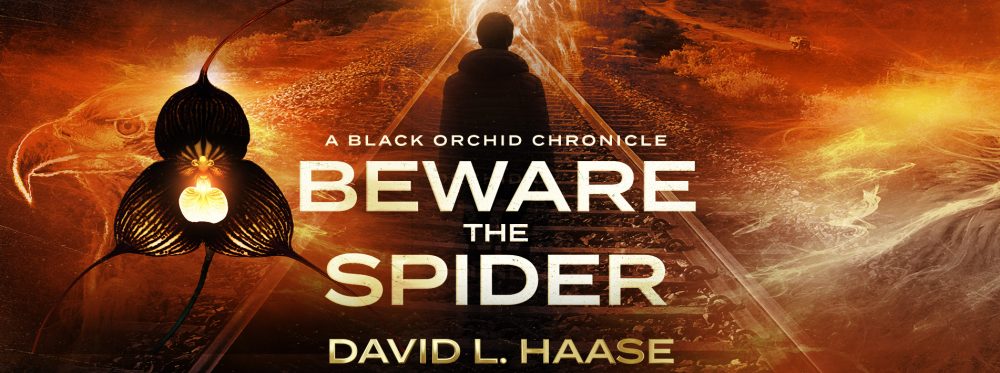
Or not. (Look at the cover of my Mark of the Spider.)

But which spider left its mark? I mean, what kind of arachnid?

This question arose (over and over and over again) as I wrote The Mark of the Spider.

A black widow (Latrodectus mactans)? Everybody knows this is the deadliest spider ever. (Except it’s probably not. It’s in the top ten, but likely not the most dangerous.)

A tarantula (spider family Theraphosidae)? Every horror movie uses these nasty looking creatures, but they rarely rank among the ten most dangerous. (See here, here, here and here.)

A Digression

In general, among the 43,000 species of spider throughout the world, the ones to avoid have funnel, recluse, widow or wolf in their names. So the black (and other) widow spiders are nasty brutes, as you would expect with a name like widow.

Depending on your source, these are the most dangerous, venomous spiders in the world.

For my money, the nastiest looking is the Goliath Birdeater Tarantula (Theraphosa blondi), which is about the size of a dinner plate. This is it:

blondilocust1 copychidsweb_thumb

Goliath Birdeater, which is about the size of a dinner plate. Photo: Wonders World.

Imagine what it would look like in person, if it were black — and 10 feet tall.

But I digress.

BOT (Back on Topic)

My spider is black with hairy legs. It has no eyes, that I can see, and it is tiny enough to crawl unnoticed into a human ear and large enough to imprison a tall man inside its telephone pole-sized legs. And angry. Very angry. And vindictive.

That’s my spider.

I couldn’t find that in nature. So, the spider in The Mark of the Spider exists in my mind, and yours. That should make you shudder.


The Mark of the Spider, Book 1 of the Black Orchid Chronicles, is available on Amazon in digital and trade paperback (5.5 x 8.5″, 334 pp.) formats.

Enjoy it today; review it tomorrow.

Ugly Face of Proofreading NSFW

Ugh.

I hate proofreading.

I hate it. It’s boring. It’s tedious. It’s exacting. (Like a religion, you must choose the one, true spelling or interpretation of grammar.)
Proofreading requires absolute focus and concentration. No interruptions; no digressions. No email. No last-minute research. And above all, no rewriting.

I get it.The MS is done. I’m just making sure the language is right. I know it’s the difference between amateur and professional, but I hate it just the same.

Today, I gathered my tools:

  • The dictionary my parents bought me for high school, now bound with duct tape.
  • A dog-eared copy of Roget’s II Thesaurus.
  • Three-ring binder containing my rewrite notes and continuity file.
  • Magnifying glass (for the dictionary).
  • Pens and scratch paper for capturing quick reminders and random thoughts.
  • The Google for fact-checking.
  • One unbound printed copy of the 540-page manuscript of The Mark of the Spider: A Black Orchid Chronicle. (Coming soon, not long after the proofing is finished.)

For five and a half hours, I toiled over trails of characters, searching for misspellings, dropped commas and all manner of English grammar traps.

For every printed page that contained multiple errors or corrections too complex for my crabbed left-handed writing, I printed a new, improved, better page. (Check for redundancy and choose the best one.)

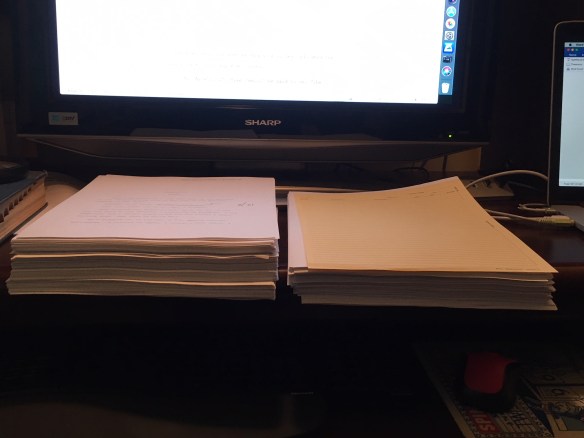
Proof desk_IMG_5020

My proofreading prison.

And when my soul cried, “No more. I can take no more,” I had reviewed only 68 pages, leaving 472 more for tomorrow and tomorrow and tomorrow.

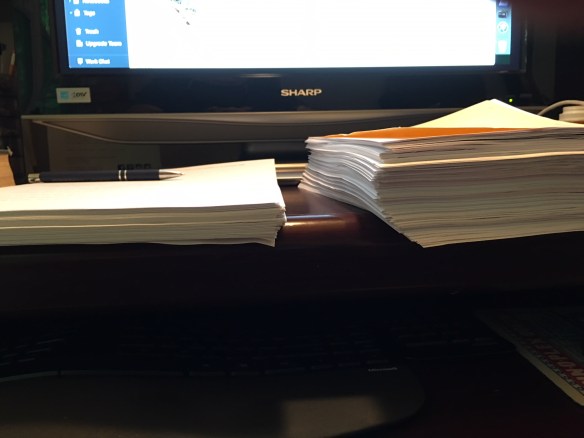
Proof day1_IMG_5021

After Day #1: Pile on the left still needs to be proofread.

Progress Update [6/20]

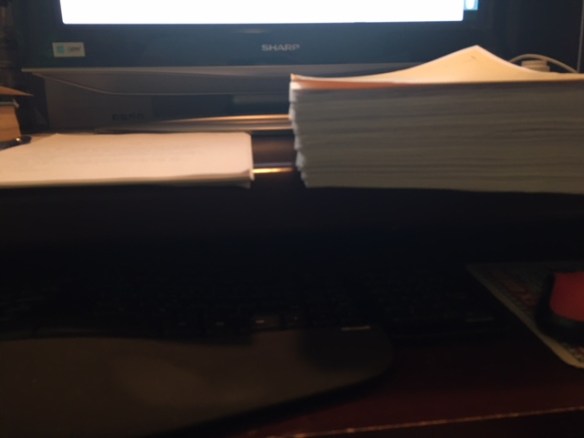
Proof day2_IMG_5022

After Day 2: Pile on the left still to be done.

Progress Update [6/21]

Proof day3_IMG_5023
After Day #3: Pile on the left awaits attention, but more than halfway there.

Progress Update [6/23]

Proof Day4

After Day #4, pile on the left requires attention. About 150 pages remain.

Progress update [6/24]

IMG_5030

After Day #5, the end (last 50 pages on the left) is in sight.

Progress update [6/25]

It’s done. Off to the designer.

IMG_5031

After Day #6, no more pages on the left to be reviewed.

Synopsis, the Value of.

The perfect synopsis, I am told, is a one-page summary that captures the struggles of the key characters, the critical actions of the plot and the overall spirit and wonder of the story.

And that’s about as easy to do as to write good, meaningful, short poetry. Take, for instance, Stopping by Woods on a Snowy Evening.

Whose woods these are I think I know.
His house is in the village though;
He will not see me stopping here
To watch his woods fill up with snow.

And so on for a grand total of four stanzas. That’s short and sweet.

It’s also written by Robert Frost. I’m no Robert Frost.

Another synopsis, one that I have found incredibly useful, is the fuller chapter by chapter description of the key actions in the plot.

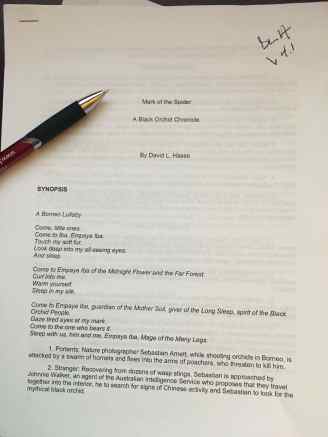
Synopsis

The Mark of the Spider synopsis, page 1

In wrapping up the ending of my novel, The Mark of the Spider: A Black Orchid Mystery, I have consulted my synopsis a dozen times or more to remind myself of precise details.

  • Was it Bozeman or Billings they hid out?
  • Was their hideout on the local road to Sacagawea Peak or Sacajawea Peak?
  • Did the would-be rescuers rush up Old Canyon Road or Bridger Canyon Road?
  • Was the ambush triggered by cell phone or laptop? (Answers below.)

More than fifty chapters (and several years) into the story, I forgot, but I needed to get things right.

My writers group reviews submissions of two or three chapters from two members once a month. That means I can’t have them review every chapter. And my chances to submit material come up months apart. No one can remember the story lines of a dozen contributors.

So the chapter by chapter synopsis serves as a reminder of what came before. Last month, the group critiqued chapters 40-42; this month, they consented to review the final four chapters (57-57). The synopsis, six singled-spaced pages by then, really proved useful for everyone.

Even writing such a long synopsis — long being easier to write than short — it takes a lot of work to wring only the critical details of each chapter out of 1,200 to 2,000 words.

But, like the continuity file, it saves time over time. If the story doesn’t flow in the synopsis, it’s probably not working in the full manuscript either.

And that’s one more value of a synopsis.

Answers:

  1. Bozeman
  2. Sacagawea Peak.
  3. Bridger Canyon Road
  4. Come on. Buy the book when it comes out. I’m not giving everything away, although I will post a chapter or two in the coming months.