Synopsis, the Value of.

The perfect synopsis, I am told, is a one-page summary that captures the struggles of the key characters, the critical actions of the plot and the overall spirit and wonder of the story.

And that’s about as easy to do as to write good, meaningful, short poetry. Take, for instance, Stopping by Woods on a Snowy Evening.

Whose woods these are I think I know.
His house is in the village though;
He will not see me stopping here
To watch his woods fill up with snow.

And so on for a grand total of four stanzas. That’s short and sweet.

It’s also written by Robert Frost. I’m no Robert Frost.

Another synopsis, one that I have found incredibly useful, is the fuller chapter by chapter description of the key actions in the plot.
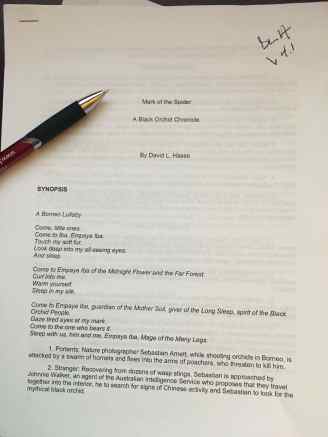
Synopsis

The Mark of the Spider synopsis, page 1

In wrapping up the ending of my novel, The Mark of the Spider: A Black Orchid Mystery, I have consulted my synopsis a dozen times or more to remind myself of precise details.

  • Was it Bozeman or Billings they hid out?
  • Was their hideout on the local road to Sacagawea Peak or Sacajawea Peak?
  • Did the would-be rescuers rush up Old Canyon Road or Bridger Canyon Road?
  • Was the ambush triggered by cell phone or laptop? (Answers below.)

More than fifty chapters (and several years) into the story, I forgot, but I needed to get things right.

My writers group reviews submissions of two or three chapters from two members once a month. That means I can’t have them review every chapter. And my chances to submit material come up months apart. No one can remember the story lines of a dozen contributors.

So the chapter by chapter synopsis serves as a reminder of what came before. Last month, the group critiqued chapters 40-42; this month, they consented to review the final four chapters (57-57). The synopsis, six singled-spaced pages by then, really proved useful for everyone.

Even writing such a long synopsis — long being easier to write than short — it takes a lot of work to wring only the critical details of each chapter out of 1,200 to 2,000 words.

But, like the continuity file, it saves time over time. If the story doesn’t flow in the synopsis, it’s probably not working in the full manuscript either.

And that’s one more value of a synopsis.

Answers:

  1. Bozeman
  2. Sacagawea Peak.
  3. Bridger Canyon Road
  4. Come on. Buy the book when it comes out. I’m not giving everything away, although I will post a chapter or two in the coming months.
Self-Pub: Still Bewildered

With the publication of my Viet Nam memoir two weeks ago, I have learned a huge amount about self-publishing.

For instance, I learned how to get it formatted properly and loaded onto more than a half-dozen book sale platforms – Amazon| AppleBarnes & Noble | Kobo | ScribdSmashwords – being the most popular.

After several tries, I managed to set up sales of paperback copies on Amazon. (Granted, I don’t understand why people who ordered it on launch day got their copies in two days, while my bulk order placed five days before launch took almost two weeks to arrive.)

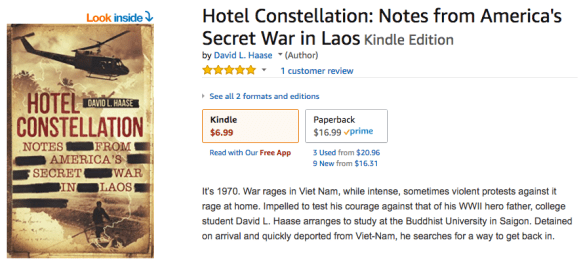
Now Amazon has thrown me for a loop again. Take a look at this screen shot and see if you can identify my quandary:

Screen Shot 2018-02-13 at 9.15.38 AM

Yep, there it is. Right under the paperback box. (Absolutely not legible on your smart phone.)

Three “used” copies of Hotel Constellation are for sale already. (Thank you for buying, whoever you are. Fast readers. Or non-readers. Thank you anyway.)

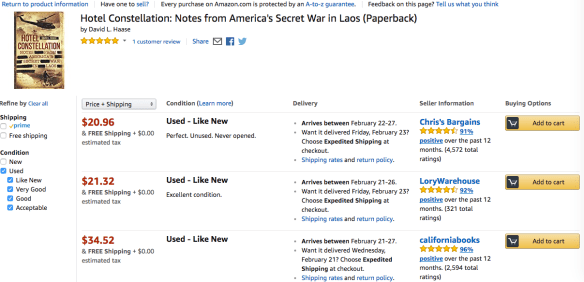
But wait. The used copies cost more, in one case really a LOT more, than a new copy.

As an old newspaper business editor, I confess I don’t understand these economics.

Screen Shot 2018-02-13 at 9.04.14 AM

Really, californiabooks, you expect to sell it used (but like new) for twice the cost of a new copy? (And the new copy comes with a FREE version of the ebook.)

Anyone with insights should contact this old dog, because he still wants to learn new tricks. (And if you’ve read it, please rate it on Amazon or Goodreads. Tnx.)


Self-Pub Aftermath 4: Marketing Works, Sometimes

After writing the book and getting it produced, the mantra for authors probably must be, “Reach out. Reach out. Reach ommmmm.”

Because of my experience with HOTEL CONSTELLATION: Notes from America’s Secret War in Laos, I am well used to rejection, or more frequently, to being ignored.

But sometimes, apparently, reaching out works, and people reach back.

Antioch logo

I queried the alumni folks at my alma mater, Antioch College, figuring that a story about one of their student’s year-abroad experience might be of interest. Last night, they contacted me and asked if I would be interested in talking with one of their writers. (Would I!)

To give them a leg up, I sent them links to the short QnAs I’ve done on Goodreads and Smashwords.

Lessons learned:

  • Slip a marketing message in wherever you can. (See previous paragraph.)
  • Sometimes it works. (Join the ORRRR Club. Order it. Read it. Rate it. Review it. Recommend it.)
  • Rinse and repeat.