12 Common Writing Mistakes

I came across this post from BookBub that identifies twelve writing mistakes that even old hands and best-sellers make.

Reading it was like being at my monthly writers group meeting. So, yeah, everyone makes these mistakes. I have, my colleagues have, and now I’m told that so do the best of us.
My Three Biggest Mistakes In Prepping For The GMAT Exam

It’s written by Ricardo Fayet, co-founder of Reedsy, which sells editing, design and marketing services to authors. Here’s the start:

Have you ever bought a New York Times bestseller and found a typo or a glaring mistake? It’s happened to most of us. Writing mistakes can detract from the overall impression of quality readers expect of a published book. This can lead to negative reviews and low ratings, which can have an undesirable impact on sales.

The occasional error is practically inevitable in a finished manuscript, but striving for perfection is still a worthy aim. Understanding the most common mistakes can help authors approach their work and editing process with more clarity — and keep them from stumbling on common pitfalls.

At Reedsy, we work with experienced developmental editors, copy editors, and proofreaders. I asked them a simple question: “What’s the most common writing mistake you see even bestselling authors making?” You’ll find their answers below, from big-picture mistakes down to the nitty-gritty of grammar and punctuation.

Read the entire post at BookBub.


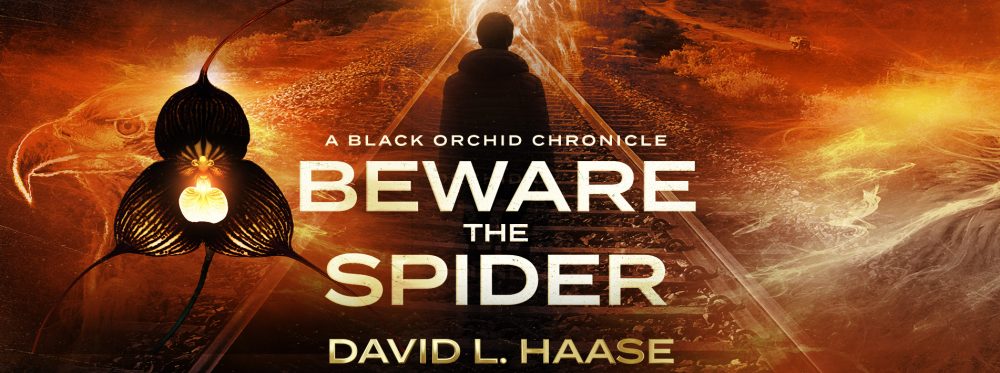
And while you’re at it, get a copy of my new novel, The Mark of the Spider, which is available from Amazon.

Buy the print copy and get the email copy free!

Still not convinced? Here’s what some readers say about it.

Inquiring Minds III (Borneo) – Mark of the Spider

Without Borneo, there would be no Mark of the Spider.

My supernatural suspense novel, the first of the Black Orchid Chronicles, follows nature photographer Sebastian Arnett, who is cursed with the power to kill with his thoughts but has no control over this lethal ability.

That curse had to come from somewhere, and I wanted a location far from the American experience in time, distance and culture. The more remote, the better. And if it was still wild, or at least untamed, even better still.

After all, the guy is going to think of people dying — as we have all done from time to time — and THEY DIE! That’s outside the normal American experience.

The opening location in the book also needed to have orchids, lots and lots of orchids. I call the series The Black Orchid Chronicles for a reason.

Worldwide, there are about 28,000 species of orchidaceae. And Borneo alone has about 1,500 species. That ought to keep a nature photographer busy for a few months documenting all those flowers for a wealthy Middle Eastern patron.

Sounds like my kind of place.

One Island, Three Nations

So, Borneo, orchids, native tribes, headhunters and demons.

The island is the third largest in the world, after Greenland and New Guinea. (Australia swamps them all, but is considered an entire continent rather than just an island.)

Still, Borneo is big enough to house (parts of) three different nations — Indonesia, Malaysia and Brunei.

Much of the action in The Mark of the Spider takes place in the Malaysian section in the north and northeast. Rural towns with names like Kota Kinabalu and Tenom host some tense scenes, and the book opens in Taman Pertanian Sabah, the Sabah Agriculture Park, with its collection of hundreds of native Bornean orchids.

As in other resource-rich parts of the under developed world, outside forces imperil the orchids and the people who live among them. Illegal logging, fires and forest damage have reduced the natural habitat of many species, and gold mining and illegal burning has led to the extinction of hundreds of orchid species.

In his travels into the Heart of Borneo, Sebastian has a fateful encounter with Dyak tribesmen. More than 200 ethnic subgroups living along the rivers and in the mountains of Borneo, each with its own dialect, customs, laws, territory and culture, make up the Dyak (also spelled Dayak).

One ancient Dyak woman presents him with a black orchid, starting a chain of events that will have Sebastian running for his life.

Borneo. Cool place. A lot happening there. Check it out.


The Mark of the Spider, Book 1 of the Black Orchid Chronicles, is available from Amazon in digital and trade paperback (5.5 x 8.5″, 334 pp.) formats.
Enjoy it today; review it tomorrow.

Ugly Face of Proofreading NSFW

Ugh.

I hate proofreading.

I hate it. It’s boring. It’s tedious. It’s exacting. (Like a religion, you must choose the one, true spelling or interpretation of grammar.)
Proofreading requires absolute focus and concentration. No interruptions; no digressions. No email. No last-minute research. And above all, no rewriting.

I get it.The MS is done. I’m just making sure the language is right. I know it’s the difference between amateur and professional, but I hate it just the same.

Today, I gathered my tools:

  • The dictionary my parents bought me for high school, now bound with duct tape.
  • A dog-eared copy of Roget’s II Thesaurus.
  • Three-ring binder containing my rewrite notes and continuity file.
  • Magnifying glass (for the dictionary).
  • Pens and scratch paper for capturing quick reminders and random thoughts.
  • The Google for fact-checking.
  • One unbound printed copy of the 540-page manuscript of The Mark of the Spider: A Black Orchid Chronicle. (Coming soon, not long after the proofing is finished.)

For five and a half hours, I toiled over trails of characters, searching for misspellings, dropped commas and all manner of English grammar traps.

For every printed page that contained multiple errors or corrections too complex for my crabbed left-handed writing, I printed a new, improved, better page. (Check for redundancy and choose the best one.)

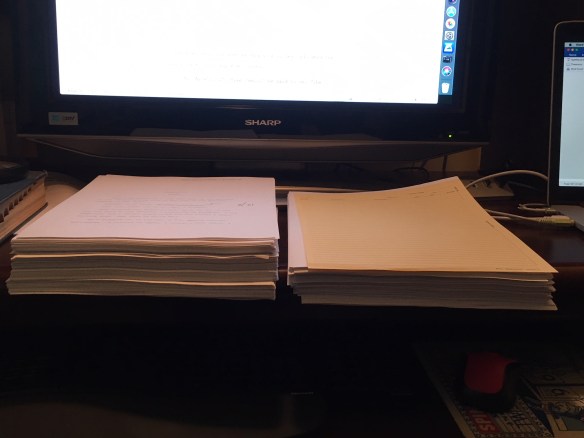
Proof desk_IMG_5020

My proofreading prison.

And when my soul cried, “No more. I can take no more,” I had reviewed only 68 pages, leaving 472 more for tomorrow and tomorrow and tomorrow.

Proof day1_IMG_5021

After Day #1: Pile on the left still needs to be proofread.

Progress Update [6/20]

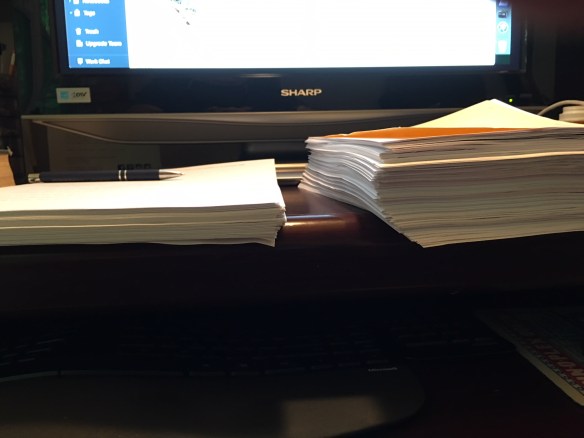
Proof day2_IMG_5022

After Day 2: Pile on the left still to be done.

Progress Update [6/21]

Proof day3_IMG_5023
After Day #3: Pile on the left awaits attention, but more than halfway there.

Progress Update [6/23]

Proof Day4

After Day #4, pile on the left requires attention. About 150 pages remain.

Progress update [6/24]

IMG_5030

After Day #5, the end (last 50 pages on the left) is in sight.

Progress update [6/25]

It’s done. Off to the designer.

IMG_5031

After Day #6, no more pages on the left to be reviewed.