Memoir Writing: No. 6 …  Gotta be Your Own Continuity Girl

Everybody — okay, maybe nobody — understands that movies are not shot in the order we see them on the screen. Otherwise, why would we need editors, right?

Actually, movie directors shoot location by location with no respect for the chronology of the on-screen story. The end of the movie might be shot first, depending on where the scene occurs, which actors and actresses are available at the time, etc.

Given that, how does the movie maker ensure that the actors are wearing the same clothes and jewelry, the window in the set is open, etc., from day to day and week to week?

That’s the job of the film notetaker, the universal memory, the script supervisor. Formerly this person was known as the continuity girl because young women tended to hold this position.

This person is always on set, always taking notes on what everyone is seeing, saying and doing. Where is the actor looking? Which hand does the actress use to slap his face?

You’ve seen the continuity screw-ups. For instance, in the Arnold Schwarzenegger movie, The Commando, Arnie totally smashes up a yellow Porsche. A few scenes later, he drives it away. That’s a continuity flub, and you want to avoid them.

What do movies have to do with writing fiction? And especially non-fiction?
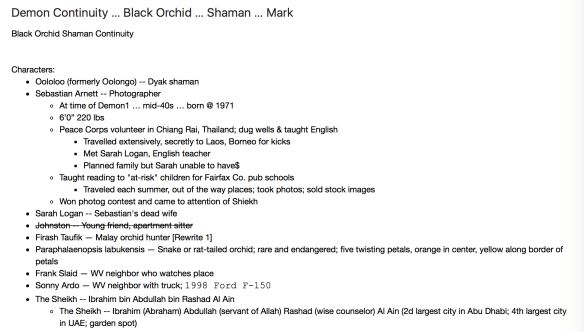
screen-shot-2016-09-18-at-8-39-04-pm

Continuity file from my Black Orchid Demon series.

You need a continuity file, too.

What is the protagonist’s dog’s name? How did he get it? (You think you’re going to remember it three months, six months, a year into writing? Huh-uh. Nope. Not going to happen.)

As your characters change, you have to keep track of them. How can the hero pull the trigger in the climax … when the villain cut off his trigger finger during their first encounter? (That’s a little drastic, but it illustrates the point. [Just another terrible pun.])

Ditto for favorite restaurant, wine, sandwich, beer, car, computer game, etc.

Continuity is especially critical for books in a series, obviously.

So, the lesson here is: You gotta be your own continuity girl, because no one else can be.

In short, after you have taken notes and drawn up your outline, keep adding to your notes. You’ll thank yourself later.

Memoir Writing: No. 5 Outline the Action

All those memories. Those photos. Those notes and boxes of stuff.

How do you turn those into a memoir?

Let’s be honest. It too early – wa-a-ay too early to think of outlining chapters.

So start with the action. Outline the action in your life.

I owe everything I know about action outlines to my high school friend, Erich Hoyt, who has written dozens of authoritative science books about killer whales and creatures of the deep. I think he also did one on ants. (He’s a smart, curious guy adept at whatever he turns his big brain to.)

When I was first trying to pull my HIDDEN WAR: A Memoir of America’s Secret Crusade in Laos together – oh back in 1995 or so – I asked Erich how to arrange all this information I had compiled. (For those who have forgotten or missed earlier blog posts, I have seven — count ‘em, seven — file boxes full of journals, clippings, photos, papers, books and assorted other documents left over from a two-year adventure in Southeast Asia.)
Action Outline-Vert.JPG

Page one of a very early draft of the action outline for HIDDEN WAR.

Erich advised me to outline the entire story based on actions I had taken or experienced. You can do a lot in two years, but when you start noting your actions — got a haircut on a street corner with a dozen Lao children staring at me — you realize quickly that some incidents are more important than others.

For instance, the haircut did not make the final cut. (OMG, that’s punishment.) But the scene where a soldier dies at my feet in a helicopter, that action rated a chapter of its own.

And here’s where those lists and your master monster chronology really pay off.

Print those files and  run through them with a highlighter in hand. No action, no highlight. Big action, highlight. (You can add the big introspective periods later, preferably tied to an … action.)

You hang all the flesh and guts of your memoir onto the action outline. This is also your story arc. It starts, and it goes along building to a climax (more later, but any kind of climax) and then it ends and you wrap it up.

If you’re not seeing the story build in the outline, maybe something is wrong with a) the outline or b) the story.

The action outline will force you to focus on the parts of your story. Does chapter one really grab the reader? What about it, i.e., what action does the grabbing? In my case, I was arrested immediately upon arrival in Saigon.

What does the climax look like? My friend’s infant daughter died, and I inherited his job as a result. (Let’s talk about the horrible unfairness of life. I got something I wanted and felt like a total shit about it.)

How are you going to end it? Did you win? Lose? Draw? My world just sort of disintegrated with the war, and I slunk out of town. Sometimes that’s the best you can do. (Slinking was one of the items in my action outline.)

In writing fiction, I fly by the seat of my pants, allowing characters to determine where the action flows. With non-fiction, I think you need a plan. I certainly did. The action outline amounted to the first draft of the plan. (Not the first draft of the memoir.)

Memoir Writing: No. 5 More on Your Chronology

In this never-ending how-to, I was going to move directly from making lists to building an action outline. As I gathered my thoughts (frolicking like sheep on a hillside), I realized how really, really, really important one of the lists is: It’s your chronology, of course.


Literally everything flows from it, no matter how you tell your story. (I’m not lobbying for a chronological telling; I’m just emphasizing how important your chronology is.)


When I was writing HIDDEN WAR: A Memoir of America’s Secret Crusade in Laos, I buried myself in stuff — seven boxes of stuff. It paralyzed me. I think this is why several earlier efforts to write about my adventures in Laos failed. Too much stuff. I didn’t know how to start.


Journalism, especially working on big projects — I once spent two years investigating corruption in Indiana’s Department of Corrections — taught me the value of starting at the beginning. That means creating a chronology of events.


What happened first? What happened second? What’s happening now?


So I started the memoir at the beginning, the day I arrived in Saigon, alone, totally unattached to the American war effort in Viet-Nam. September 24, 1970. I was a few months past my 20th birthday.


But that’s not where my chronology began.


My first entry recorded an event that happened 21 years earlier. It reads: “Oct. 2, 1949 — Mao Zedong proclaims PRC. [Source, page number]”


For the record, that’s before I was born. And, it was also not the very first thing I wrote in the chronology. But in the completed 86-page, single-spaced document, it appears first because along the way it became clear I needed to know when the “crusade” I was writing about began. In my mind, it began the day the People’s Republic of China was born.


That’s how you build your chronology. Backward, forward, any which way it needs to go. You add and add and add to it. I was adding to it even as I wrote chapters. It kept everything in order. It was the one place I could go back to and expect to find, if not the answer I sought, clues to where I might find what I needed.


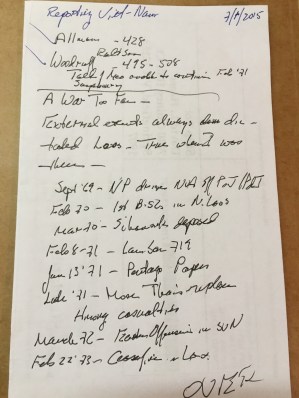
I extracted shorter chronologies from the master, monster chron as I was writing chapters. This is a draft of a chapter chronology I used to write about what I learned about reporting.


Handwritten Chron_Reporting

A mini-chronology pulled from the master monster chronology.

What do you put into your chronology? Absolutely everything that you think might be important.
  • Journal entries. (I think maybe I have to write something about dealing with journals and diaries.)
  • Correspondence excerpts.
  • Source material (books, documents, drafts, memos to yourself) summaries or extracts.
  • Newspaper and magazine clippings.
  • Recollections inserted roughly where they would go if they had been from a letter or a journal.
  • Questions about what was happening or why there are no data for a period.
  • Reminders.
  • Pictures, drawings, artwork.
Do you use all of this stuff?


Not in the sense that you include everything in your manuscript, but you do consult it. Just putting material into the chronology can help jog a foggy memory.


How long does it take? Almost forever.


But it also saves an eternity of searching for material, trying to remember if Event A came before, after or at the same time as Event B. And it can provide insight as you look back and realize that a minor occurrence at the time actually had a much larger impact than you expected.


I repeat: Everything flows from the chronology. It forces you to remember events and order them in sequence. When you write, you can jumble them any way you like. But build the chronology first.