Where Life-Changing Decisions Are Made

Recently, while zipping west on I-70, I detoured south on U.S. 68 and dropped in on my alma mater, Antioch College, for the first time in more decades than I care to say.

It got me to thinking, as these things will, about life-changing decisions, how we make them and even where we make them. (It’s not like there’s one place that everyone goes, sits down and says, Let’s change the life a bit.)

Ye Olde Trail Tavern_IMG_5042

Ye Olde Trail Tavern, Yellow Springs, Ohio, where life-changing decisions are made.

As I strolled through beautiful downtown Yellow Springs, Ohio (pop. 3,487), I spied Ye Olde Trail Tavern, a place I might have frequented with my favorite professor in my misspent youth. (Any youth that is not misspent is wasted.)

What a change from the last time I saw it, back in the early 1980s. It had a neon sign!

It was here, in 1969, that I decided I go to Viet Nam, albeit not in the U.S. military.

I explained it this way on page 38 of my memoir, HOTEL CONSTELLATION: Notes from America’s Secret War in Laos:

When I started talking about dropping out because the education I chose was not matching the financial sacrifices my family and I were making, Dan came up with a truly radical idea: I should go to Viet Nam to study for a year under the Antioch Education Abroad (AEA) program.

I don’t remember exactly when he presented it as an option. Well, you could do another co-op term, or you could go to Viet Nam, he probably said. Hey, there’s an idea, Dan. I think I’ll go to Viet Nam. I hear it’s quite the spot.

We might have been sitting in a booth at the Olde Trail Tavern, a dive on the main drag through Yellow Springs. Dan and I downed a few pitchers of beer there, he holding court for me, the avid acolyte.

AEA sent a lot of kids to foreign countries, mostly in Europe, a few to South America, and even fewer to places like Kenya, Nigeria, and India. Going to Viet Nam was an intriguing idea, straight out of the “put up or shut up” school of decision making. We noodled over what it would take and how it would work. Paula Spier, a middle-aged, motherly member of the AEA staff, bought into it.

And in August 1970, I flew off for two of the most intriguing years of my life.

It’s all in HOTEL CONSTELLATION, and copies still available from Amazon, Apple, Barnes & Noble, Kobo, Scribd, Smashwords and other fine booksellers.

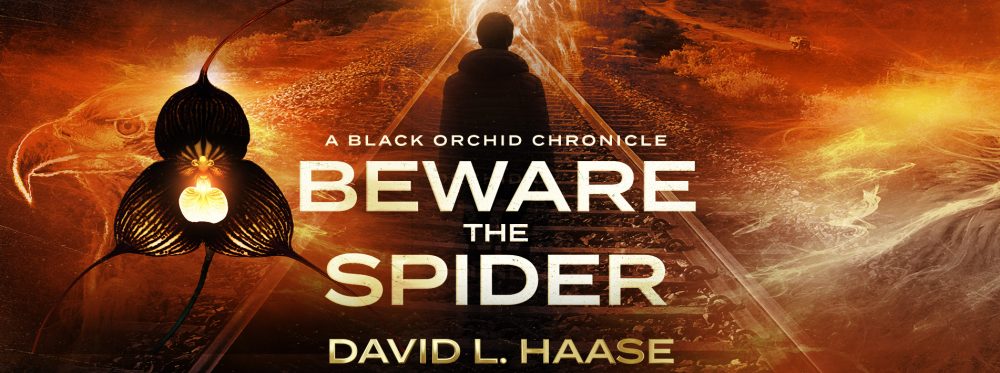
It might even explain how I came to write my new book, The Mark of the Spider, but probably not.

Mark of the Spider – A QnA

People often ask me — no, they don’t, but I expect they will — what’s this about spiders in your new book, The Mark of the Spider?

I usually (will) tell them something like this:

The mark in The Mark of the Spider refers to a spider web tattoo that covers the right side of the face of any person cursed by the spider demon.

The Mark of the Spider - 3D-small

Like the cover here?

How very perspicacious, I respond.

My hero, Sebastian Arnett, photographs nature for a living after the death of his wife. He encounters an aged native woman while working in Borneo and is given a black orchid. Unknown to him, accepting the orchid is to accept a curse and a deadly new power from the spider demon.

That’s pretty interesting, they (will certainly) say. But how did you come to write about spiders and demons? That doesn’t sound like you at all.

Oh, I (will definitely) say. You have no idea what goes on in this mind of mine. But back to your question of how I came to combine the two.

I can’t recall at this point. I’ve been working on The Mark of the Spider (and two other Black Orchid Chronicles) for at least four years. But it probably grew out of my fascination with taking macrophotos of flowers. Orchids are particularly complex and often difficult to photograph. So that’s the orchid part. Spiders? I just don’t know. I guess I was looking for something creepy to pair with orchids. I think the pairing works out pretty well in the book.

So, these preternaturally curious people (will) then ask about the Black Orchid Chronicles. What are they?

The chronicles comprise a trilogy of stories featuring nature photographer Sebastian Arnett and a small recurring cast, including:

  • Col. Mike Owens, USMC – A military officer assigned to watch over Sebastian after his deadly, secret power becomes clear

  • Joe – An ancient Indian medicine man who sees spirits

  • Amanda – Wealthy Denver businesswoman who steals Sebastian’s heart

  • T – Precocious twenty-something bastard son of Amanda’s former husband

  • Jimmy Beam – Ethnologist and operative of the Australian Intelligence Service

  • The Sheikh – Fabulously wealthy Middle Eastern patron of Sebastian’s photography

  • Empaya Iba – The Spider Demon

That sounds like a fascinating ensemble. I hope there are a lot more chronicles, they (will) say.

Well, you’ll just have to stay tuned.

One last question, they (will) insist: Is there such a thing as a black orchid? I’ve never seen one.

Well, you’ll just have to read the book, won’t you? I reply testily, because that’s the kind of grump I am.

One more thing: The ebook version of The Mark of the Spider: A Black Orchid Chronicle is available right now for preorder on Amazon.

The paperback will be available, also from Amazon, on August 15.

Antioch Magazine Spotlights My Laos Memoir

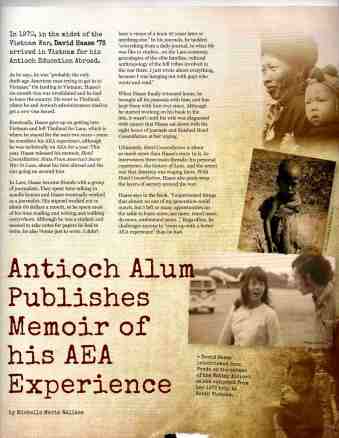
The Antioch College Alumni Magazine just came out with a very nice write-up about my memoir, HOTEL CONSTELLATION: Notes from America’s Secret War in Laos.

The one-page spread includes three photos of mine and that picture of me interviewing Jane Fonda waaaaay back in 1972.

About 40,000 Antioch alumni, including this Class of ’73 grad, received copies of the four-color 58-page magazine. It’s part of the effort to rebuild the mother campus in Yellow Springs, Ohio, after the school had to shut down for lack of funding. (Yeah, colleges do close.)

I’m grateful to writer Michelle Marie Wallace, who listened to me ramble about my experiences, and to Carol Krumbach, who commissioned the piece.