Memoir Writing: No. 3 My Indispensable Tool

When I was writing HIDDEN WAR: A Memoir of America’s Secret Crusade in Laos, I was working from a large number of sources:

  • Two hand-written journals kept in spiral notebooks
  • More than 50 rolls of black and white film scanned into digital files
  • Hundreds of letters, most hand-written
  • Course evaluations for my undergraduate degree (Laos was my year abroad that stretched to two years.)
  • Files, notes and course work from graduate school
  • More than 100 books, most in paper versions but including a dozen or so in digital formats
  • Five folio-sized scrap books of newspaper and magazine clippings
  • Files full of carbon copies of articles I wrote
  • Dozens of paper and digital maps of Laos and surrounding countries

It’s no wonder I started and stopped half a dozen times before I finally got it right and finished.

I wrote and edited the manuscript in MS Word, but my notes and everything else I did on Evernote, my indispensable writing tool.

Disclaimer: I am not a shill for Evernote, have never received free software, blah, blah, blah, and I absolutely hate some things about the program.

But I never would have finished the memoir without it, and I use it a dozen times a day to keep my schedule, take notes and leave myself reminders, and pull down content from the Web and social media. Of the 1,250 or so files currently in Evernote, the Laos folder holds 299, including the sample below.

Screen Shot 2016-08-07 at 6.38.13 AM

Evernote grabs and stores research from the Web and displays material in useful sidebars.

Here’s what I like most about it:

  • It works with all operating systems and devices. When I was writing Hidden War, I was working with a Windows PC, an Apple MacBook Pro, an iPad, and an Android cell phone and later an iPhone 6s Plus. Whatever I wrote or stored on one version of Evernote appeared on every other device and platform just fine.
  • It lives on the cloud (see above), but you can store some or all of your files on a particular device. I back up all my files every month and keep a separate backup of the Laos material.
  • It offers lots of options when you want to grab stuff from the Web, including (my favorite) just the content without all the ads and other Web blather.

I suspect it does much more but that’s how I rely on it.

I wrote the original draft of all my chapters on Evernote before combining them on MS Word. That’s my system.

What I hate is the limited formatting options and the worst autocorrect function I have ever used.

Some people swear by Scrivener, but I could never figure it out.

Find your own indispensable writing tool. You’re about to do some heavy lifting.
Memoir Writing: No. 2 Taking Notes

Wallowing in the past can be great fun.

Thumbing through journals can enlighten and horrify.

Writing in Tokyo on my way to Viet-Nam, I observed: “Smog is very bad. I see why eight people died here in August.”

Reading old letters brings back the old times.

A postcard I sent to a girl friend (later my wife) reported: “Thing are quite a bit more expensive than I had planned, thus I am cutting everything short.”

Newspaper clippings take snapshots in time.

Richard Nixon said on March 6, 1970, “No American stationed in Laos has ever been killed in ground combat operations.” Two days later, he corrected that to say seven had died. (History books record the correct number as 27.)

Old photos produce giggles.

DLH-cu_EK_0176 copy

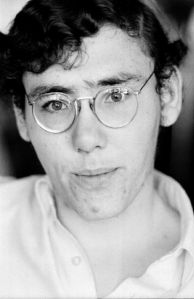
Me in 1970

The smirk on my face was caused by chewing on a toothpick, something I still do.

Enjoy the stroll down memory lane. It will spark other memories, and they may be needed down the line.

But there’s work to be done. This isn’t a lark. This is memoir writing.

You have to take notes as you wallow.

Let me repeat: You have to take notes.

Otherwise, you will find yourself rereading those journals and letters and clippings and trying to find that one priceless photo that spoke a thousand words.

How you take notes and where you keep them is up to you. Whatever works for you is what works. But you have to take notes.

Memoir Writing: No. 1 Wallowing

Step One in writing a memoir is to acknowledge that you have a lot of stuff; you’re not sure where it is or where it will go but you know you have it.

Step Two, start rounding up the stuff.

No — No — No.

That’s all wrong.

Before you start gathering all the stuff, write an outline … on paper … in pencil.

I recommend paper so you don’t wear out your backspace key. Or your printer’s ink cartridge.

The outline for this puppy is going to change a hundred times … the first day.

Okay, so BEFORE you outline, just jot down ideas … in no particular order. Stuff you want to remember. Incidents. People. Places. (This jotting down process can be lengthy, and I recommend using a steno pad or a three-ring note binder. The steno pad is easier to carry around.)

My first list went something like this: Memoir … for kids … Laos after expelled from Viet-Nam … draft status … mugged in Bangkok … Hotel Constellation … crotch rot / writing in underwear. WHERE ARE JOURNALS. START THERE.

And so on.

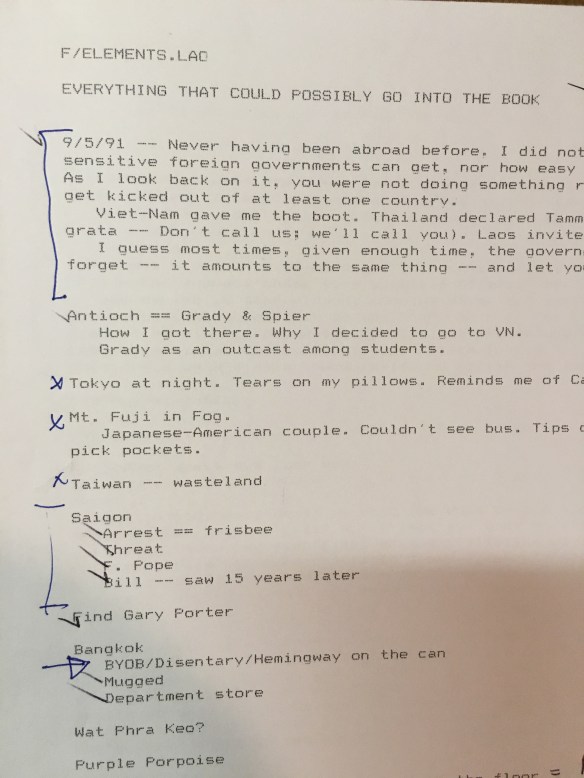
During my 1991 effort to organize things, I compiled my handwritten lists and typed them into a computer file named “Elements.” The header for the file read “EVERYTHING THAT COUILD POSSIBLY GO INTO THE BOOK.” That file was later subsumed into a file named “Plan,” and on it went.

Elements_Everything Better

I believe in wallowing. Just soaking up information and generating impressions. I keep doing it until I get bored. Then I stop and try to find something constructive to do. Or move on to another project.

So, Step No. 1 to writing a memoir is to wallow in information, impressions, and sensations. Also, alcohol.

(To be continued.)