Memoir Writing: #9 It’s Time to Write

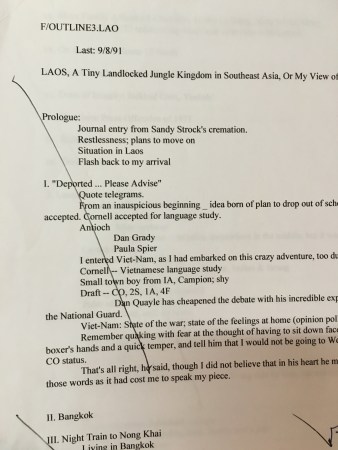
The research and prep work are done.

You’ve got your outline.

Now you write.

You can start anywhere you like, but I think the beginning is a better place than most. I don’t mean the day you were born. I mean the beginning you chose in your outline. ;INK

This a memoir, not an autobiography. An autobiography covers your entire life and really does start at the very beginning. Your memoir is focusing on part of your life.
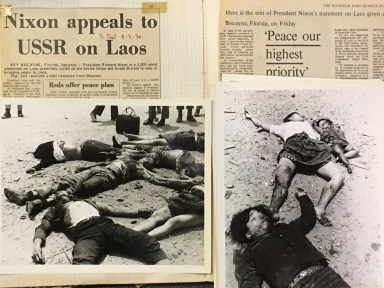
 

inside-clip-book

One of my clipping books: Reasons to write.

Use all your senses to tell your story. How you felt. Sure. But what did you see? Hear? Smell?

Keep your eye on the conflict. If this was important enough to write about, identify the conflict and keep it in mind, and on the page.

Wrap it up with a satisfying ending. Doesn’t have to be happy. But it has to address and resolve the conflict somehow.

Along the way, use quotations. Journal entries. Letters. News clippings.

Given my decades as a journalist writing every day and several years of writing 2,000 words of fiction a day, I thought I could knock out a first draft of a 75,000-word manuscript in two months with a little weekend work. Wrong. It took five months.

Be flexible about your deadlines, but by all means set a goal for yourself.

After you finish, go back and revise it. Start to finish. Spellcheck. Grammar check. Does everything make sense? Is everything consistent? Did you have any questions? If you did, you can bet your readers will, too. So answer them.

After your first revision, pass it around to anyone who will read it. Get real reader feedback. You don’t have to take the advice you get, but you should hear it and consider it. Someone cared enough to make suggestions; they deserve a respectful hearing.

I was lucky enough to have more than a dozen people – family, friends and my writers group – review all or parts of the memoir. After the first revised draft, I did two complete rewrites with uncounted numbers of revisions.

So you should plan to rewrite and repeat. Expect it to take a while.

Have fun. Life is short. Good luck.


Memoir Writing: #8 Enticing Titles

In the old days – say, the 1800s – people called their memoirs “Memoirs“.

Personal Memoirs of U.S. Grant by Ulysses S Grant.

Memoirs of General WilliamT. Sherman by Himself.

More recently, memoir titles have turned cryptic.

Eat. Pray. Love.

When Breath Becomes Air.

I mean, WTF?

The Girl with the Lower Back Tattoo. Which, given that it’s by Amy Schumer, is probably tongue in cheek and so should be forgiven for it crypticness.

hotel-constellation_ek_0077-copy

Hotel Constellation

I rather like titles like Out of Africa by Isak Dinesen.

West with the Night by Beryl Markham.

Borrowed Time: An AIDS Memoir by Paul Monette.

If I were to emulate some of my favorite generals, I should call my book My Personal Memoirs of David L. Haase by Myself.

If I went the cryptic route, I could call it Gruyere on French with a Side of Noodles.

Yeah. Those aren’t happening.

So what does a terrifically average guy who had an ordinary life with one brief unusual interlude call his memoir? And what criteria should you use for your memoir?

Despite the popularity of the cryptic titles – I would call them cute – I think a memoir needs a title that is descriptive, enticing and concise.

I say that as a reader, not as a successful author, which I’m not. That is, I’m a successful reader, not a writer. Successful writer. (Which explains a lot.)

Since my memoir has not been published – and in fact, it’s only been read by a dozen people – I should perhaps describe it.

Before Viet-Nam, there was Laos — a secret war planned, manned and covered up by the CIA. To this day most Americans know nothing about it. For almost two years in the early 1970s, I followed that secret war as an apprentice journalist. I was barely 20 and naive, but I knew how to take notes.

HIDDEN WAR: A Memoir of America’s Secret Crusade in Laos, a 77,500-word readable narrative of investigation and exploration, is born of my journals and thousands of pages of research. It is a coming-of-age story of a time when Cold War sentiments drove the U.S. into the disastrous war in Viet-Nam — with its tragedy spilling over into neighboring Laos and Cambodia.

Not just a personal adventure, Hidden War contains lessons for our nation when America seems unable to untangle itself from civil wars in the Middle East. It is a reminder that foreshadows the dangers facing America and the world today — with lessons to be considered anew.

As I groped for a title, I felt it had to contain these elements, if not these words:
  • Eye grabber / The BIG PRINT
  • Memoir / Memories / Recollections — NOT a history
  • Secret
  • War/Conflict
  • Laos / Viet-Nam / Indochina

Among the 100 or so alternatives, here were a few that I shopped around for feedback:

  • Lessons of War: My Education from America’s Secret Crusade in Laos
  •  Conflicted Self: A Non-combattant Memoir of America’s Secret War in Laos
  •  In the Way of War: A Memoir / Learning from America’s Secret Crusade in Laos, 1970-1972
  •  Second-Hand War: A Memoir / Learning from America’s Secret Crusade in Laos, 1970-1972
  • Window on the War: America’s Secret War in Laos from the Constellation Hotel
  • Hotel Constellation: Notes from America’s Secret War in Laos
I selected the last one for the manuscript I sent to my immediate family and a very small group of long-time, incredibly patient and wonderfully loyal readers (of not just the memoir but the other crap I’ve written.)

The Hotel Constellation had special meaning for me, and I wanted to share that with my family. It was my living room, my mailbox, my lifeline to the past and home away from home for two long and trying years of my life. It deserves to be remembered, if only by a handful of people.

I realized the phrase would mean nothing to most readers, so for them (and the agents and publishers I have yet to attract), I went with a different title.

HIDDEN WAR: A Memoir of America’s Secret Crusade in Laos

I think it’s descriptive. I hope it’s enticing. The main title, Hidden War, is concise.

That’s what I was aiming for. The process took years. Better luck with your title.