Memoir Writing: #9 It’s Time to Write

The research and prep work are done.

You’ve got your outline.

Now you write.

You can start anywhere you like, but I think the beginning is a better place than most. I don’t mean the day you were born. I mean the beginning you chose in your outline. ;INK

This a memoir, not an autobiography. An autobiography covers your entire life and really does start at the very beginning. Your memoir is focusing on part of your life.
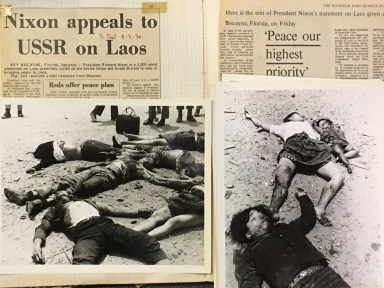
 

inside-clip-book

One of my clipping books: Reasons to write.

Use all your senses to tell your story. How you felt. Sure. But what did you see? Hear? Smell?

Keep your eye on the conflict. If this was important enough to write about, identify the conflict and keep it in mind, and on the page.

Wrap it up with a satisfying ending. Doesn’t have to be happy. But it has to address and resolve the conflict somehow.

Along the way, use quotations. Journal entries. Letters. News clippings.

Given my decades as a journalist writing every day and several years of writing 2,000 words of fiction a day, I thought I could knock out a first draft of a 75,000-word manuscript in two months with a little weekend work. Wrong. It took five months.

Be flexible about your deadlines, but by all means set a goal for yourself.

After you finish, go back and revise it. Start to finish. Spellcheck. Grammar check. Does everything make sense? Is everything consistent? Did you have any questions? If you did, you can bet your readers will, too. So answer them.

After your first revision, pass it around to anyone who will read it. Get real reader feedback. You don’t have to take the advice you get, but you should hear it and consider it. Someone cared enough to make suggestions; they deserve a respectful hearing.

I was lucky enough to have more than a dozen people – family, friends and my writers group – review all or parts of the memoir. After the first revised draft, I did two complete rewrites with uncounted numbers of revisions.

So you should plan to rewrite and repeat. Expect it to take a while.

Have fun. Life is short. Good luck.
 

Memoir Writing: No. 7 Shuffling Events

You’ve got your action outline, which grows every time you look at it.


It’s not time to start culling. (That will come, and you will be merciless, more or less, if you want to finish this thing.)


Before you start writing – and we are getting very close – you need to escape from the straightjacket of chronology.

 
Your chronology is your chronology. It can grow or shrink, but events always stay in strict chronological order.
 

The action outline is different. It’s the skeleton you will hang your story onto.


It will probably remain roughly chronological, but it doesn’t have to.
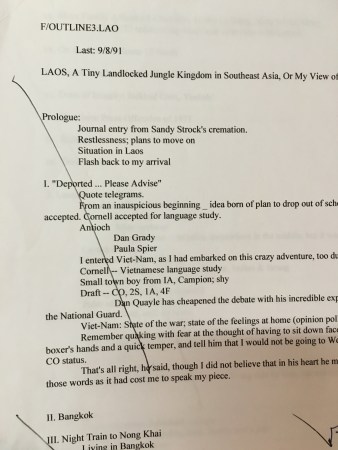
action-outline-1991

Action Outline #3 … It all got moved around.

For most of us, some periods of our lives are busier, and more significant, than others. These periods tend to be more memorable. Nobody wants to read about our routine … until something interrupts it and the extraordinary, or at least unusual, occurs.


For instance, my routine of teaching English, studying Lao and doing research in the government archives was interrupted by word that a coup might be taking place. Memorable.


I had not written much about the teaching, studying and research even though it occurred very close to the beginning of my chronology. So I moved the timing of some of the events that created the routine, or normalcy, and wrote about them in the coup chapter (which did not survive rewrites).


I think you get the point.


You can’t move the climax, but you can tinker around with events leading up to or contributing to it.


Figure out how long your chapters might be. How much can you cram into one? Then start shuffling events or incidents to plug holes, shorten a complex chapter or improve the flow of the narrative.


We are almost ready to start writing. First, we will do a title. But now is the time to rearrange that action outline.


Memoir Writing: No. 6 …  Gotta be Your Own Continuity Girl

Everybody — okay, maybe nobody — understands that movies are not shot in the order we see them on the screen. Otherwise, why would we need editors, right?

Actually, movie directors shoot location by location with no respect for the chronology of the on-screen story. The end of the movie might be shot first, depending on where the scene occurs, which actors and actresses are available at the time, etc.

Given that, how does the movie maker ensure that the actors are wearing the same clothes and jewelry, the window in the set is open, etc., from day to day and week to week?

That’s the job of the film notetaker, the universal memory, the script supervisor. Formerly this person was known as the continuity girl because young women tended to hold this position.

This person is always on set, always taking notes on what everyone is seeing, saying and doing. Where is the actor looking? Which hand does the actress use to slap his face?

You’ve seen the continuity screw-ups. For instance, in the Arnold Schwarzenegger movie, The Commando, Arnie totally smashes up a yellow Porsche. A few scenes later, he drives it away. That’s a continuity flub, and you want to avoid them.

What do movies have to do with writing fiction? And especially non-fiction?

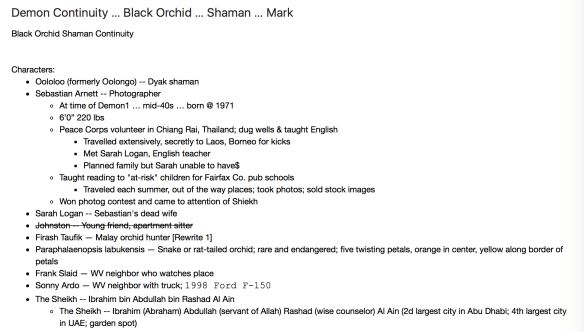
screen-shot-2016-09-18-at-8-39-04-pm

Continuity file from my Black Orchid Demon series.

You need a continuity file, too.

What is the protagonist’s dog’s name? How did he get it? (You think you’re going to remember it three months, six months, a year into writing? Huh-uh. Nope. Not going to happen.)

As your characters change, you have to keep track of them. How can the hero pull the trigger in the climax … when the villain cut off his trigger finger during their first encounter? (That’s a little drastic, but it illustrates the point. [Just another terrible pun.])

Ditto for favorite restaurant, wine, sandwich, beer, car, computer game, etc.

Continuity is especially critical for books in a series, obviously.

So, the lesson here is: You gotta be your own continuity girl, because no one else can be.

In short, after you have taken notes and drawn up your outline, keep adding to your notes. You’ll thank yourself later.