
Memoir Writing: No. 2 Taking Notes

Wallowing in the past can be great fun.

Thumbing through journals can enlighten and horrify.

Writing in Tokyo on my way to Viet-Nam, I observed: “Smog is very bad. I see why eight people died here in August.”

Reading old letters brings back the old times.

A postcard I sent to a girl friend (later my wife) reported: “Thing are quite a bit more expensive than I had planned, thus I am cutting everything short.”

Newspaper clippings take snapshots in time.

Richard Nixon said on March 6, 1970, “No American stationed in Laos has ever been killed in ground combat operations.” Two days later, he corrected that to say seven had died. (History books record the correct number as 27.)

Old photos produce giggles.
DLH-cu_EK_0176 copy

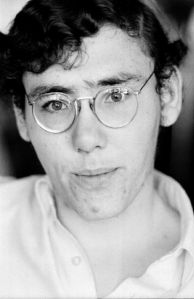
Me in 1970

The smirk on my face was caused by chewing on a toothpick, something I still do.

Enjoy the stroll down memory lane. It will spark other memories, and they may be needed down the line.

But there’s work to be done. This isn’t a lark. This is memoir writing.

You have to take notes as you wallow.

Let me repeat: You have to take notes.

Otherwise, you will find yourself rereading those journals and letters and clippings and trying to find that one priceless photo that spoke a thousand words.

How you take notes and where you keep them is up to you. Whatever works for you is what works. But you have to take notes.
Memoir Writing: No. 1 Wallowing

Step One in writing a memoir is to acknowledge that you have a lot of stuff; you’re not sure where it is or where it will go but you know you have it.

Step Two, start rounding up the stuff.

No — No — No.

That’s all wrong.

Before you start gathering all the stuff, write an outline … on paper … in pencil.

I recommend paper so you don’t wear out your backspace key. Or your printer’s ink cartridge.

The outline for this puppy is going to change a hundred times … the first day.

Okay, so BEFORE you outline, just jot down ideas … in no particular order. Stuff you want to remember. Incidents. People. Places. (This jotting down process can be lengthy, and I recommend using a steno pad or a three-ring note binder. The steno pad is easier to carry around.)

My first list went something like this: Memoir … for kids … Laos after expelled from Viet-Nam … draft status … mugged in Bangkok … Hotel Constellation … crotch rot / writing in underwear. WHERE ARE JOURNALS. START THERE.

And so on.

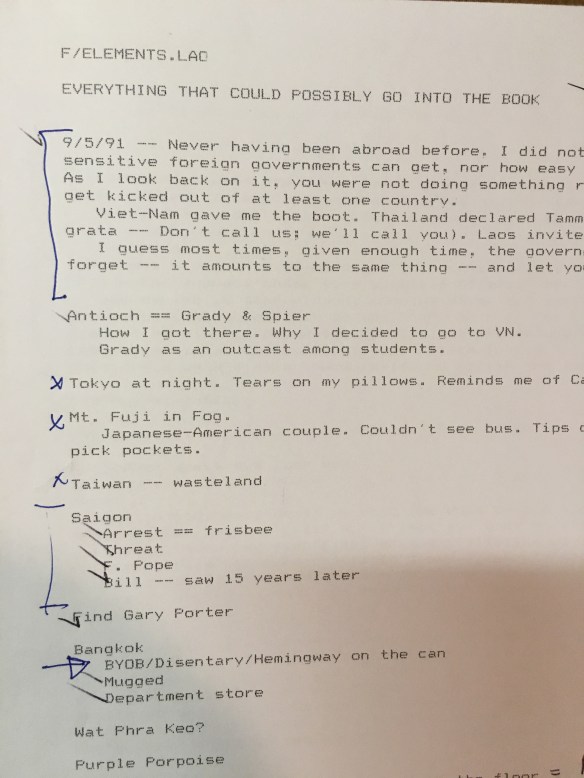
During my 1991 effort to organize things, I compiled my handwritten lists and typed them into a computer file named “Elements.” The header for the file read “EVERYTHING THAT COUILD POSSIBLY GO INTO THE BOOK.” That file was later subsumed into a file named “Plan,” and on it went.

Elements_Everything Better

I believe in wallowing. Just soaking up information and generating impressions. I keep doing it until I get bored. Then I stop and try to find something constructive to do. Or move on to another project.

So, Step No. 1 to writing a memoir is to wallow in information, impressions, and sensations. Also, alcohol.

(To be continued.)

Memoir Writing: A How-To

A funny thing happened on the way to my conversion from reporter/columnist to fiction writer: I wrote a memoir.

It was unintended, which is to say, never intended, never planned, never imagined.

But my wife made a special request, and, well, here we are.

First, I’m old but not that old. Which is to say, I do have some things I remember.

Second, I thought I had something worth remembering and writing about. You see, while other men of my age cohort in the Baby Boomer Generation were moving heaven and earth to avoid the draft and stay out of the ugly, bitterly divisive and deadly war in Viet-Nam, as a second year student in college I actively pursued that goal, to witness the war from Vietnamese eyes. That out of the ordinary experience, while not unique, was worth remembering, especially since it involved getting kicked out of Viet-Nam and spending two years in Southeast Asia.

Over the years, I tried unsuccessfully — really unsuccessfully — to write up the 10 or 12 most interesting stories from that formative period. Eventually I let it drop and the boxes of journals, notes and books from that era filled the least accessible storage space in our basement. (Photo of the boxes coming to a post soon.)

Third, as I was struggling to learn the ins and outs of novel writing — it’s harder than it looks, even for a long-time journalist who knows his way around a dictionary — life handed my family one of those crises that make everything (and I mean everything) pale in comparison. My concentration went out the window, and I simply could not write one more detail that needed to be invented.

My wife’s solution: Pick up the memoir again. You don’t need to make anything up. You just have to remember.

Thank you, honey. That was good advice.

And so, about a year later, I wrapped up HIDDEN WAR: A Memoir of the CIA’s Secret Crusade in Laos.

And here’s how I did it:

(To be continued.)

BTW, we weathered the crisis, and I am now immersed in rewriting the first book in what I expect will be the Demon series: Mark of the Spider. It’s coming along nicely — all right, in fits and starts — but I’m back on fiction.