Memoir Writing: No. 5 More on Your Chronology

In this never-ending how-to, I was going to move directly from making lists to building an action outline. As I gathered my thoughts (frolicking like sheep on a hillside), I realized how really, really, really important one of the lists is: It’s your chronology, of course.


Literally everything flows from it, no matter how you tell your story. (I’m not lobbying for a chronological telling; I’m just emphasizing how important your chronology is.)


When I was writing HIDDEN WAR: A Memoir of America’s Secret Crusade in Laos, I buried myself in stuff — seven boxes of stuff. It paralyzed me. I think this is why several earlier efforts to write about my adventures in Laos failed. Too much stuff. I didn’t know how to start.


Journalism, especially working on big projects — I once spent two years investigating corruption in Indiana’s Department of Corrections — taught me the value of starting at the beginning. That means creating a chronology of events.


What happened first? What happened second? What’s happening now?


So I started the memoir at the beginning, the day I arrived in Saigon, alone, totally unattached to the American war effort in Viet-Nam. September 24, 1970. I was a few months past my 20th birthday.


But that’s not where my chronology began.


My first entry recorded an event that happened 21 years earlier. It reads: “Oct. 2, 1949 — Mao Zedong proclaims PRC. [Source, page number]”


For the record, that’s before I was born. And, it was also not the very first thing I wrote in the chronology. But in the completed 86-page, single-spaced document, it appears first because along the way it became clear I needed to know when the “crusade” I was writing about began. In my mind, it began the day the People’s Republic of China was born.


That’s how you build your chronology. Backward, forward, any which way it needs to go. You add and add and add to it. I was adding to it even as I wrote chapters. It kept everything in order. It was the one place I could go back to and expect to find, if not the answer I sought, clues to where I might find what I needed.


I extracted shorter chronologies from the master, monster chron as I was writing chapters. This is a draft of a chapter chronology I used to write about what I learned about reporting.
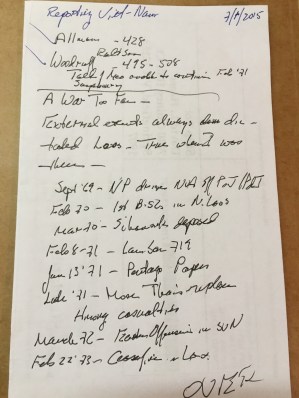
 

Handwritten Chron_Reporting

A mini-chronology pulled from the master monster chronology.

What do you put into your chronology? Absolutely everything that you think might be important.
  • Journal entries. (I think maybe I have to write something about dealing with journals and diaries.)
  • Correspondence excerpts.
  • Source material (books, documents, drafts, memos to yourself) summaries or extracts.
  • Newspaper and magazine clippings.
  • Recollections inserted roughly where they would go if they had been from a letter or a journal.
  • Questions about what was happening or why there are no data for a period.
  • Reminders.
  • Pictures, drawings, artwork.
Do you use all of this stuff?


Not in the sense that you include everything in your manuscript, but you do consult it. Just putting material into the chronology can help jog a foggy memory.


How long does it take? Almost forever.


But it also saves an eternity of searching for material, trying to remember if Event A came before, after or at the same time as Event B. And it can provide insight as you look back and realize that a minor occurrence at the time actually had a much larger impact than you expected.


I repeat: Everything flows from the chronology. It forces you to remember events and order them in sequence. When you write, you can jumble them any way you like. But build the chronology first.

Memoir Writing: No. 4 Organization by List Making

All right. By this time, you have wallowed in your boxes of memories, started taking notes, concluded that you need a consistent note-taking software, platform or notebook.

Now what? As in, what do you do with all those notes?

Files Boxes-Stacked

Three of seven boxes of memorabilia that had to be entered into lists for my memoir, “Hidden War.”

Easy. Make lists.

  • Chronology — Your most important list. Everything flows from this. Everything refers back to this. Your memoir does not have to follow this religiously, but you must have it and know that you can rely on it. That is, you know everything on it is true and accurate, to the best of your knowledge and ability.
  • Names — What? Who needs a list of names? You can remember the name of every person you’ve ever met. Fine. Keep the list anyway. And make sure you know that it’s Aunt Ida, not Aunt Ada. Or in my case, Aunt Bernice. Only in my case there were two Aunt Beas, both with the same last name. One was Big Aunt Bea, because my mother’s aunt was older and larger than Little Aunt Bea, my mother’s sister who was also called Ditz. (Don’t go there.)
  • Places, otherwise known as maps.
  • Books, articles, newspaper clippings, AKA Bibliography.

Why all the lists? Because you can’t remember everything, and you don’t want to even try. You want to rely on your lists.

For that reason, anything that goes into a list must be fact-checked and completely accurate … OR LABELED AS UNVERIFIED.

We will add other lists later, but for now, these are the keys to organizing all those memories.

BTW, this process took me about 42 years with many starts, stops and interregna. That’s why ACCURACY IS KEY. (Yes, I know I’m shouting. I’m doing it because you don’t believe me and aren’t paying attention.) You don’t want to have to go back and start over checking every list entry to confirm that it’s accurate.

In the next step, we start writing. Sort of.

Memoir Writing: No. 3 My Indispensable Tool

When I was writing HIDDEN WAR: A Memoir of America’s Secret Crusade in Laos, I was working from a large number of sources:

  • Two hand-written journals kept in spiral notebooks
  • More than 50 rolls of black and white film scanned into digital files
  • Hundreds of letters, most hand-written
  • Course evaluations for my undergraduate degree (Laos was my year abroad that stretched to two years.)
  • Files, notes and course work from graduate school
  • More than 100 books, most in paper versions but including a dozen or so in digital formats
  • Five folio-sized scrap books of newspaper and magazine clippings
  • Files full of carbon copies of articles I wrote
  • Dozens of paper and digital maps of Laos and surrounding countries

It’s no wonder I started and stopped half a dozen times before I finally got it right and finished.

I wrote and edited the manuscript in MS Word, but my notes and everything else I did on Evernote, my indispensable writing tool.

Disclaimer: I am not a shill for Evernote, have never received free software, blah, blah, blah, and I absolutely hate some things about the program.

But I never would have finished the memoir without it, and I use it a dozen times a day to keep my schedule, take notes and leave myself reminders, and pull down content from the Web and social media. Of the 1,250 or so files currently in Evernote, the Laos folder holds 299, including the sample below.

Screen Shot 2016-08-07 at 6.38.13 AM

Evernote grabs and stores research from the Web and displays material in useful sidebars.

Here’s what I like most about it:

  • It works with all operating systems and devices. When I was writing Hidden War, I was working with a Windows PC, an Apple MacBook Pro, an iPad, and an Android cell phone and later an iPhone 6s Plus. Whatever I wrote or stored on one version of Evernote appeared on every other device and platform just fine.
  • It lives on the cloud (see above), but you can store some or all of your files on a particular device. I back up all my files every month and keep a separate backup of the Laos material.
  • It offers lots of options when you want to grab stuff from the Web, including (my favorite) just the content without all the ads and other Web blather.

I suspect it does much more but that’s how I rely on it.

I wrote the original draft of all my chapters on Evernote before combining them on MS Word. That’s my system.

What I hate is the limited formatting options and the worst autocorrect function I have ever used.

Some people swear by Scrivener, but I could never figure it out.

Find your own indispensable writing tool. You’re about to do some heavy lifting.