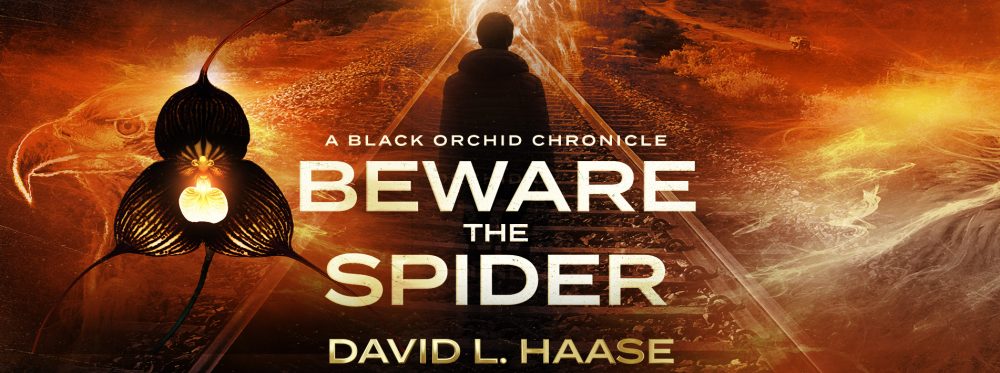
Inquiring Minds (Australian Spies) – Mark of the Spider

An Australian spy, Johnnie Walker by name, stands out as one of the first key characters to appear in my supernatural suspense novel, The Mark of the Spider.

Johnnie, who describes himself as an economic attache in the Australian consulate in Borneo, sidles up to nature photographer Sebastian Arnett in a bar in Tenom and offers to buy him a drink.

Ever skeptical,  Sebastian susses out that more lies behind this offer than a simple act of friendliness.

That drink leads Sebastian to near catastrophes, visions of the mythical black orchid and an encounter with headhunters. And the story is just getting underway.

Australia-Borneo map

Australia in the 1850s. Borneo is off to the northwest. Photo: National Library of Australia

As Johnnie and his colleagues in the Australian Intelligence Service pop up from time to time throughout the book, it’s fair to ask how much of their story is fact and how much is fabricated. The short answer is, neither Johnnie nor AIS is real, but the intelligence interests I write about are.

Borneo lies more than 3,400 miles (5,480 km) northwest of Australia. That’s a seven and a half hour flight, but in the vastness of the Southwest Pacific, the two countries rank as relatively close neighbors.

So, it stands to reason that Australia would want to keep track of events in Borneo, and who better to do the job than a fictional guy like Johnnie Walker of the Australian Intelligence Service.

And, like most countries, Australia employs a long list of secretive groups devoted to gathering and analyzing information about the world around it and the dangers that world might pose.

Just for fun, I did a little research into the real Australian spies after making up my own. I learned that the real Australian intelligence community is organized around six umbrella agencies:

  • Australian Security Intelligence Organisation
  • Australian Secret Intelligence Service
  • Australian Signals Directorate
  • Defence Intelligence Organisation
  • Defence Imagery and Geospatial Organisation
  • Office of National Assessments

Johnnie would probably find a job in the Australian Secret Intelligence Service, which is not to be confused with the Australian Security Intelligence Organization (real) or the Australian Intelligence Service (fabricated).

Yum, alphabet soup from Down Under.

You can get an overview of the Australian intelligence community in the 2011 Independent Review of the Intelligence Community Report, which can be found online here.


The Mark of the Spider is available in ebook and trade paperback editions from Amazon.

Inquiring Minds III (Borneo) – Mark of the Spider

Without Borneo, there would be no Mark of the Spider.

My supernatural suspense novel, the first of the Black Orchid Chronicles, follows nature photographer Sebastian Arnett, who is cursed with the power to kill with his thoughts but has no control over this lethal ability.

That curse had to come from somewhere, and I wanted a location far from the American experience in time, distance and culture. The more remote, the better. And if it was still wild, or at least untamed, even better still.

After all, the guy is going to think of people dying — as we have all done from time to time — and THEY DIE! That’s outside the normal American experience.

The opening location in the book also needed to have orchids, lots and lots of orchids. I call the series The Black Orchid Chronicles for a reason.

Worldwide, there are about 28,000 species of orchidaceae. And Borneo alone has about 1,500 species. That ought to keep a nature photographer busy for a few months documenting all those flowers for a wealthy Middle Eastern patron.

Sounds like my kind of place.

One Island, Three Nations

So, Borneo, orchids, native tribes, headhunters and demons.

The island is the third largest in the world, after Greenland and New Guinea. (Australia swamps them all, but is considered an entire continent rather than just an island.)

Still, Borneo is big enough to house (parts of) three different nations — Indonesia, Malaysia and Brunei.

Much of the action in The Mark of the Spider takes place in the Malaysian section in the north and northeast. Rural towns with names like Kota Kinabalu and Tenom host some tense scenes, and the book opens in Taman Pertanian Sabah, the Sabah Agriculture Park, with its collection of hundreds of native Bornean orchids.

As in other resource-rich parts of the under developed world, outside forces imperil the orchids and the people who live among them. Illegal logging, fires and forest damage have reduced the natural habitat of many species, and gold mining and illegal burning has led to the extinction of hundreds of orchid species.

In his travels into the Heart of Borneo, Sebastian has a fateful encounter with Dyak tribesmen. More than 200 ethnic subgroups living along the rivers and in the mountains of Borneo, each with its own dialect, customs, laws, territory and culture, make up the Dyak (also spelled Dayak).

One ancient Dyak woman presents him with a black orchid, starting a chain of events that will have Sebastian running for his life.

Borneo. Cool place. A lot happening there. Check it out.


The Mark of the Spider, Book 1 of the Black Orchid Chronicles, is available from Amazon in digital and trade paperback (5.5 x 8.5″, 334 pp.) formats.
Enjoy it today; review it tomorrow.

Book Parts (Dedication) – Mark of the Spider

Book dedications are special. You should read them.

After all the work the author has put into writing the book, he or she devotes a few words to one or more special people.

Dedications are not acknowledgements, which simply let the reader know that more than one person helped out.

Paraphrasing the Free Dictionary definition, a dedication is an announcement to the world of affection or esteem.

In my Viet-Nam era memoir, HOTEL CONSTELLATION: Notes from America’s Secret War in Laos, I went overboard and dedicated the book to half of the people I knew at the time. Every one of those people deserved the dedication.

With my latest book, The Mark of the Spider, I point out two people who were special not only in my life in general but were special to all the work I did on the book.

My wife, Elizabeth, leads this exclusive list. She has encouraged me to write books almost since the day we met 50 years ago this summer. I could write a lot more about her, but you get the idea. Fifty years.

John Morrow-bw vert_IMG_8947

John Morrow, nature photographer. Photo: Sharon Lerner

The other dedication goes to John Morrow, (1947-2009).

We knew each other only a decade. We shared a few similarities, like our dirty hands blue-collar backgrounds, but were in most ways very different people.

John did a handful of things to perfection — construction, photography, shooting, cooking, mentoring —  and I like to watch people doing the things they love.

He made things, at first small things like leather goods and later much bigger things, like the U.S. Institute of Peace on the National Mall.

usip

U.S. Institute of Peace model. Photo: http://www.mediate.com


John loved to grill, and my wife and I enjoyed watching him tango around his wife, Sharon, in the kitchen he built for them.

Like so many self-made people, he had endless curiosity but a determined ability to focus on one thing at a time.

When he died (far too young) at the age of 62, John was devoting more and more of his time to photographing wildlife, in particular bears, moose and other potentially deadly critters.

It is no coincidence that Sebastian Arnett, the protagonist in The Mark of the Spider, is a nature photographer.

Almost ten years after delivering a eulogy for his life, I find myself still missing the evenings we spent together, drinking red wine, listening to music and arguing over who played what instrument on the arrangement.

I am fascinated that our differences enhanced our friendship. I think readers might recognize that theme in The Mark of the Spider.

The next time you take up a book, I hope you will read the dedication and find a little something that you can identify with. I’m pretty certain that is what the author intends.